Sunday, June 10, 2007

Sterile Ethnic Cleansing

The dim light fed into the Jaffa tent. Light, the shape of diamonds, vaguely illuminated the space. The couch and cushions were comfortable. They were red—black lines decorated the surface. The place was filled with a relaxing smoke. Troubles were far away, except for the troubles of the mind. Like the smoke that lingered in our tent, troubling thoughts filled my mind.

These weeks and these days have been different—they have been new indeed. These days have been refreshing and exhausting.

I remember sitting in a small simple shop called Sultan where they serve tea, coffee, and Argeela. We all sat in silence, thinking perhaps, or simply enjoying each other’s company. After telling some childhood stories to one another, Mohammed shared his favorite childhood memory. He remembers walking through the fruit tree fields in his village. It was a joy to harvest the apricots. He liked sitting in the shade of the apricot trees sipping tea with mint leaves and talking with his father. They each would taste-test a number of apricots just to make sure they were alright. Mohammed is the leader in his village now.

I thought this was the most appropriate memory for the existing situation here. The land where these trees once stood has now been flattened. The trees uprooted. More land, more trees, more fruit is disappearing. Memories, though seemingly existing only in the mind, will never be repeated in these fields.

It is sad.

But there are hundreds of people protesting this loss of land, loss of memory, loss of life. The loss seems inevitable. But the enthusiasm, commitment, and energy put into protecting this livelihood points to something amazing, powerful, and victorious. We are on the verge of seeing a something courageous, something astounding.

Walking through the bulldozed, treeless land was strange, it felt bare and wrong. This land is supposed to have trees. The trees are supposed to be giving fruit by now. The people are supposed to be able to harvest this fruit. This valley, this land is not supposed to be a sewage dump.

_________________

Land confiscation is a very common occurrence in Palestine. This refers to land within the pre-June 1967 Green Line. The “Green Line” is an international recognized border that separates Israel proper from the West Bank (Palestine). Land within the West Bank is regularly confiscated for settlement expansion, water rights, and “security.” The place described above is a village called Artas in a fertile valley near Bethlehem. Like so many other places in the West Bank, the land being confiscated in Artas will serve the expansion of a nearby settlement called Efrata. (According to international law, the settlements within the West Bank are illegal—certainly settlement expansion.) The land that is being taken (from the story above) is going to be used as a sewage dump for Efrata. Artas valley, as mentioned, is extremely fertile. Thousands of poor farmers depend on its soil for their livelihood. Now this valley is being turned into a sewage dump, which according to those who have crunched the numbers, will most likely spill over soon after construction and destroy the entire Artas valley, disenfranchising thousands of farmers and rendering life in Artas unlivable. Artas is a characteristic example of the type of intimidation, illegal expansion, and all out ethnic cleansing that Israel has routinely been engaged in the occupied Palestinian territories (West Bank and Gaza). While in Artas and many other cases Israel does not explicitly or forcefully expel the local Palestinian population, they, through a vast complex of apartheid-esque tactics that make normal life unsustainable.

Thursday, June 7, 2007

Aida II

This wall separates the people of Aida refugee camp from their olive fields
This land will eventually be annexed to the "Greater Jerusalem" plan
We made some friends there
The Mosque in Aida

Wednesday, June 6, 2007

Monday, June 4, 2007

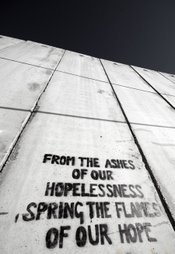
Springs the Flames of Our Hope


From the Ashes of Misery

From the ashes of misery springs the flames of our hope
The burning embers of repression reap resilient resistance
The whimsical dance of the flame’s delight burns my eyes
And all I can see is fields and fields never ending
Of trees of olives of apricots, freedom, there is none sweeter

From cracks in walls of oppression shines the light of our dreams
The mirage holds and flickers just long enough to never be forgotten
The sharp brightness of the sun’s rising hints at something new
And my eyes fix on the sun’s gleaming rays only to see myself
Of resistance and the creativity of suffering and then the sun sets

From the sting of violence flow rivers of resistance
The repression acts as fuel and ignites a fire of love in my heart
The fire to confuse and consume all the evil you can muster
And my gaze is steady my path as sure as stone, bright as the sun
Of Satygraha and soul force to end the occupation of my mind, my body

From the vengeance of yesterday’s deaths springs tomorrow’s forgiveness
The memory of martyrs unnumbered haunts my weary heart
The pains of scars innumerable pains my tired body
And my hands bleed they are crushed under the captivating weight of mercy
Of love of enemy and many tomorrows of possibility for musalaha, for reconciliation

From the darkness of hate shines the light of understanding
The illumination of reality to expose the powers for the sham that they are
The strong steady chant of a people courageous enough to demand respect
And all I can hear on this dark road is the chant of child soldiers of peace
Of children and the right to refuse to fear that which has abandoned all creativity

From eyes tired and weary there is love that endures suffering
The eyes of one who has seen what should not be done
The eyes of a child of Bethlehem who has done what should not be seen
And the walls great shadow gives me shelter from the sun
Of weariness and the soothing monotony of oppression’s deep shadow

From concrete and clay, wood and water, comes life
The white buildings intensely reflecting the sun rays
The brown mountains picturing sporadic olive trees
And the people stare from their white buildings to the brown fields
Of olive trees and abandoned vineyards, of broken cities and isolating walls

Sunday, June 3, 2007

Checkpoint 300

Checkpoints are a daily reality for Ahmad. Ahmad with his wife and six children live in a small but cozy two room apartment in Dheisheh refugee camp. On their wall, interjected between time worn pictures of beloved family members who live in Gaza that Ahmad and his family haven’t seen in over ten years, hangs a rusted key. It’s large and iconic. Symbolic and sublime. Rusted by time and tempered with the flame of creative nonviolent resistance. It is a constant reminder of the Palestinian right of return, ensured by United Nations resolution 194 but never implemented thus far. Ahmad’s 6 year old daughter, Haleema, grins and giggles as she responds with boldness and pride: “Artas!” when she’s asked the name of the village that her grandparents and great and great great and even great great great grandparents are from. Where she is from.

Her grandparents were expelled from Artas in 1948 as Israel committed wholesale ethnic cleansing of much of Mandatory Palestine under the cover of regional war. Hundreds of thousands of Palestinians fled or were driven from their homes and farms to decrepit refugee camps in parts of Jordan, Egypt, Lebanon, Syria, and what would become known as the West Bank and Gaza Strip. Today there are over 5 million Palestinian refugees. None of which have been given the right to return to their original villages. Once there was a house with a door where the rusted key that hangs on the wall fit into. To be a Palestinian refugee is to remember. Memory is the closest thing that Palestinian refugees have to identity and self determination.

Ahmad makes his living as a day laborer in Jerusalem. Each morning Ahmad wakes at 3am in order to arrive at checkpoint 300 at 4am. By the time he gets there the line to enter the checkpoint which is supposed to open at 5am but usually doesn’t until after 6am is already hundreds of people long. The permit he was lucky to receive from the Israeli government allows him to travel into Jerusalem and work from 5am to 7pm. If he returns late, even once, he will lose his 3 month work permit which he paid 2,000 shekels for ($500). Over the course of the year Ahmad will pay $2,000 simply to be able to travel into Jerusalem—a fifteen minute drive—to work.

There are many different kinds of checkpoints throughout the West Bank ranging from earth mounds and crude roadblocks manned by IOF’s (Israeli Occupation Force) to massive compounds complete with 27ft walls, sniper towers, turnstiles, metal detectors and manned by heavily armed IOF’s. Checkpoint 300 in Bethlehem is one of the largest and most imposing. It is the checkpoint between Bethlehem and Jerusalem. In order to leave or enter Bethlehem Palestinians have to cross through checkpoint 300. Setting aside the fact that lines to pass through the checkpoints commonly stretch hundreds of meters and that there are regular multi hour delays and the fact that Palestinians are frequently not allowed to pass through for petty and arbitrary reasons, any Palestinian that wishes to pass through checkpoint 300 into Israel must obtain a permit. What this means is that Palestinians must apply for a permit through the Israeli government. As you might imagine actually obtaining a permit is near to impossible.

We were there today. At 5am we were there. At checkpoint 300. As the sun rose over the horizon the line that was already hundreds of meters long continued to grow. Today was a good day. The checkpoint opened on time. Palestinians young and old were still herded like animals, some were still turned away to return to their families having made nothing for the day, and everyone was forced to wait hours to take a 15 minute trip to work. But today was a good day.

Saturday, June 2, 2007

Nonviolent Fridays


Here the young Palestinian activists are pushing a boulder into land currently being confistacted in order to be used for a sewage dump in the area called Ertas. (This is for Josh). If this sewage dump is completed, it is likely that its capacity will overflow into the entire Ertas valley, destroying the livelyhood of thousands of Palestinians in the most fertile valley around Bethlehem.

Friday, June 1, 2007

Are you listening to me?

Are you listening to me?
I always do.
I’m feeling weird.
Tell me more.
Like falling in love. Like butterflies and sadness.
Well do you like it?
I can’t.
Why?
Because I don’t know what it is.
I wish I could help you.

Did you see those walls?
Yes, they were beautiful.
Beautiful?
Didn’t you see the colors and the green fields and trees?
I wish I could.
Look harder.
All I see is walls and pill box sniper towers.
Can’t you imagine if it were…
True? That those weren’t just paintings? If only
You could imagine hard enough to make your dreams real

Maybe your stomach is upset.
I don’t think so.
Maybe the oppression you have seen makes you a little sick?
Maybe.
I appreciate you being here. Do you know that?
It’s not enough.
It’s all you have. All that can be.
I could learn to live with you. Share your pain and love you.
You know that can’t be.
But my stomach tells me I want it to be true.

Palestine.
Yes?
Where is there hope?
There is hope in the struggle.
Yes, but it feels more like sadness.
To you.
What does it feel like to you?
Like a wonderful dream that can’t be. Like beautiful pictures on the wall of my cage.
Well at least there’s that. At least the hope of frustration. There is beauty in that.
At least. But then…

Sometimes I wonder.
Wonder what?
Wonder what it would be like.
It?
Freedom.
You have it.
But for you.
Yes, I wonder about that too.
Do you ever cry?
Never.

How’s your stomach?
It hurts. Well it feels empty and dizzy.
I know what you mean.

Thursday, May 31, 2007

Wahlad


House of Nakba


Her eyes were tired, like her soul was tired. Her look was drained. Her house was no longer. She has been through horrific hardship. The house that once stood there, on the hill, had been demolished… for the second time.

The door still stood upright amid the broken cement walls. The door had a window, perhaps a window of hope.

Taking someone’s land is like taking someone’s life. Destroying someone’s house is like destroying their soul.

The family stands on the rubble. Mother, father, and son. Their struggle is long and difficult. An eternal struggle it seems.

The father looks at me and says, “Everywhere this is the same, the same story, the same same.

Go to Jenin, same same. Go to Lebanon, same same. Go to Gaza, same same. Same same. It’s not so different.”

But there is hope, right? Perhaps to rebuild the house for the third time? But, will the bulldozers come a third time? Will the house stand, remain?

The rebar, twisted and bent, lay scattered around the broken house. But the window in the door stood out, perhaps as hope for the future. A window of hope? A door to a better future? It stood there, alone.

“We want to live in peace with our neighbors. We don’t hate the Israelis, the Israelis are good people. But look at what the powers are doing.

What can we do?”

Tuesday, May 29, 2007

Monday, May 28, 2007

Young lad


IDF Incursion to Dheisheh Camp


Nonviolent Action


http://youtube.com/watch?v=YnR6YoodHEU&mode=related&search=

Talate

The coffee’s good here. Really good. You learn to appreciate small things in prison. Haleema means wise in English. I appreciate that. I think it’s beautiful. By the time the “security barrier” is finished it will snake over 450 miles, annexing 25% of the West Bank—farms, houses, businesses. If I told you that it’s illegal in the West Bank for a Palestinian to dig a well, what would you say? Or what if I told you that the water that runs through pipes in Palestinian cities in the West Bank can be turned off by remote control somewhere in Israel? What then?

Smoke and the smell of unwashed bodies filled the room. “Don’t go outside!” Ibrahim shouted. I looked out the window. Each time I looked light from a spotlight reflected off the smooth glass of my lens reminding me not to look too closely. I stepped back from the window and reflected on a completely new feeling. Occupation. As I felt fear unlike any I have felt before the snarl of Hebrew over loudspeakers drowned out the rumbling sound of piston engines in the otherwise silent night in Bethlehem. And I could not help but wonder if infrared night vision could differentiate between an American and a Palestinian.


There’s an enormous cockroach in my room. Jeremy the cockroach. He’s there because I don’t kill bugs. Not because it makes me sad—I’m not that sympathetic; bugs just scare the shit out of me. No, I would rather pretend he isn’t there, that somehow he’ll dissolve into nothingness…but somewhere in the back of my mind I know he’s going to scuttle out when I least expect it. The thought crawls around in my brain, poking in my subconscious near the other thoughts I ignore with the vague hope that they will just go away. I lay in my bunk at night wondering what it must be like for people here—knowing they are just Jeremy, crawling hopelessly around in the brains of the only people who can save them from their prison. The difference is that Jeremy can pop out and scare me anytime he feels like it. Most of the people here can’t leave. They probably never will.

Still, the children laugh. Life goes on. Their ability to adapt to occupation will never cease to amaze me. They paint on the walls of their refugee camps, the place where they are forced to live because they’ve lost everything. Yet these murals don’t depict hatred and revenge. They are their dreams of life outside of prison. When I encounter a sort of fear I have never felt before, the men tell me that this invasion wasn’t so bad. I nearly cried I was so afraid. A boy said that if he did not have to hide from the soldiers with his family, he would have thrown stones at them with the other boys. They are beautiful and broken with strength I could never have imagined…while I pretend Jeremy doesn’t exist.


I stand there on the concrete, the sun in my face, my eyes squinting, and my skin burning. A bead of sweat rolls down my cheek. I stare at the wall—it’s big and overwhelming. I just stand there staring. The wall is made of concrete, but it’s not as thick as I had expected. Nonetheless, this “security barrier” cuts off the people’s livelihood, their olive trees, their fields, their houses. “Hate builds walls, hope builds bridges.” Who is hate, and why is he building walls? Who is hope, and where are all the bridges?

The explosions go off in the camp. The soldiers are back again, but this time they do not bother to use the roads in the camp. They’re going through the buildings, literally. They’re using explosives to tear through the camp, making huge holes in the walls of homes, causing horrific noise, great pain, and even death. As the little girl’s mother stood by the door waiting for the soldiers to knock, the wall and door blew up in her face and sliced her. The soldiers didn’t let the girl’s father call the ambulance until several hours later. The little girl’s mother died. What do you say to that?